Note
As we move through the Cold War, be sure to remember that the people of the 1950s-1970s had their experiences, their fears, their evidence, etc. At times, they saw events, ideas, people, etc. accurately; at times, they made flawed decisions based on flawed judgments and flawed information.
As Americans today are influenced by previous and current decades (which includedinclude the Vietnam War, Watergate, conflicts in Iraq and Afghanistan, Al -Qaeda/ISIS, the recent depression, Facebook and Twitter, smart phones), they were guided by the 1930s (e.g., depression), 1940s (World War II and the development of nuclear weapons), and 1950s (Korean War and Cold War). They were influenced by changes in gender and race relations, the developing “generation gap,” the availability of news and information, perceptions of the country’s place in the world, perceptions of threats of all kinds (from national security to medical to social), etc.
Most simply, do not look for “one-note” explanations . . . and keep in mind that a year can end quite differently than it started and, as a result, change a country. (Compare Americans on the evening of September 10, 2001, and on the evening of September 11.)
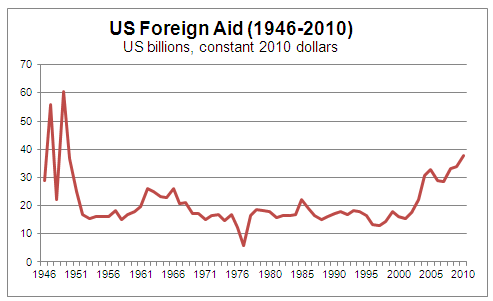
Finally, do not see “involvement” and economic/advisory (and even military) aid as the same as war or do not see them as inevitable steps to war. (The U.S.’s containment policy was highlighted by regional alliances and economic/technical/military assistance. Beyond western Europe (Marshall Plan), recipients included South Korea, Iran, Nationalist China, the Philippines, Liberia, Egypt, Saudi Arabia, Eritrea, Israel, Ethiopia. “Point Four . . . was the basis for the Agency for International Development (AID), a $35 million program that provided technical assistance to the Third World. The Point Four program, according to a State Department official, sought “to strengthen and generalize peace . . . by counteracting the economic conditions that predispose to social and political instability and to war.” (http://www.americanforeignrelations.com/E-N/Foreign-Aid-The-cold-war-foreign-aid-program-1947-1953.html#ixzz4u78gOWUT) Clearly that Cold War aid did not lead to the commitment of 500,000 American troops and years of bombing, the loss of 60,000 American lives, and the deaths of millions of native peoples.)